Comments on

Modern Language Models Refute Chomsky’s Approach to Language

LLMs, linguistic theory, and the shifting burden of proof
ZHENG YUAN (Byron)
LPL, Aix-Marseille University (AMU)
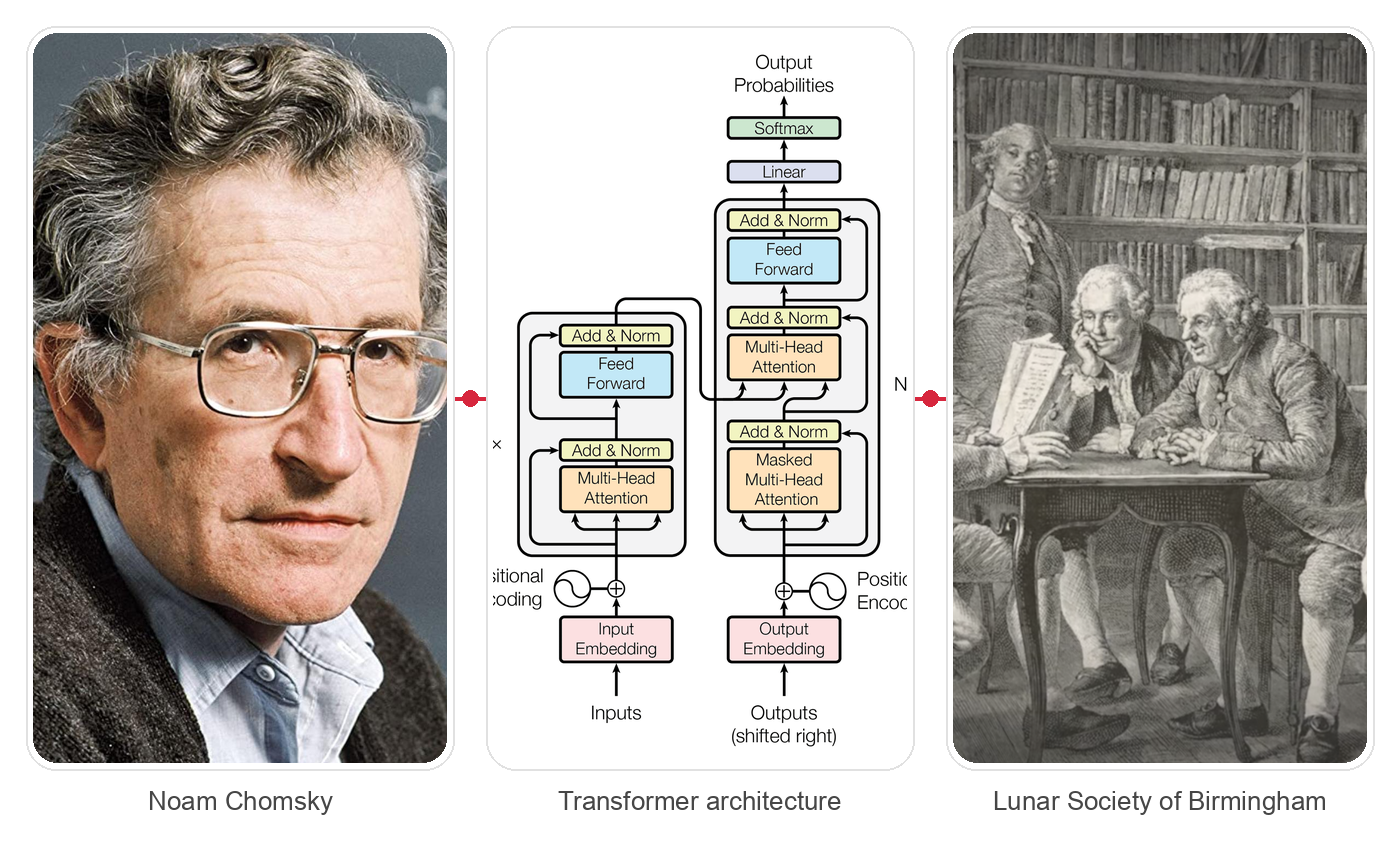
Chomsky, Transformer architecture, and the Lunar Society of Birmingham
2 · The provocation

Do LLMs refute Chomskyan linguistics?

Classical generative view
S NP VP Det N V PP
Modern LLM view
text
next-token prediction
trained transformer
Three questions we must keep separate:
  • Can a model perform linguistic behavior?
  • Can it learn it from plausible input?
  • Does it do so by a human-like neural & cognitive mechanism?
Piantadosi (2024)
3 · Two pictures of language

Two contrasting explanations of linguistic knowledge

A strong generative viewPredictive neural-network view
Grammar relies on specialized, structured principlesGrammar-like structure can emerge through learning
Syntax is relatively autonomousSyntax and semantics are integrated
Key constraints may be innateGeneral learning biases + data may suffice
Explanation prioritizes explicit formal structureExplanation begins with implemented predictive behavior
Simplified — neither tradition is monolithic. Piantadosi targets strong claims of necessity, not every version of generative linguistics.
Piantadosi (2024)
4 · What an LLM actually does

One objective: predict what comes next

The authors who the banker sees ___ tall.
Context → transformer representations → probability distribution
are0.91
is0.03
were0.02
To predict are (not is), the model tracks the long-distance dependency on authors — not the nearest noun banker.
Prediction is not the endpoint — it is the learning signal.
Syntactic structure (object relative clause)
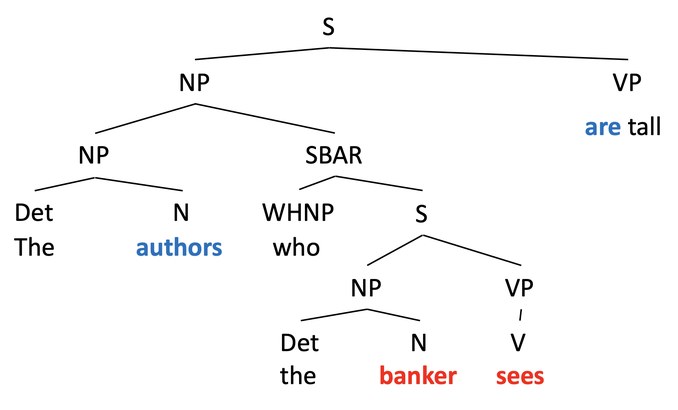
Parse tree from Marvin & Linzen (2018)
Agreement accuracy across an object relative clause
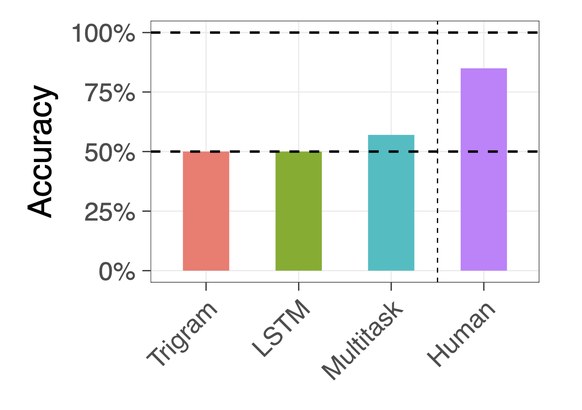
Model vs. human agreement accuracy (Marvin & Linzen, 2018)
(Marvin & Linzen, 2018)
5 · Beyond “just autocomplete”

The empirical claim: structure-sensitive behavior can emerge

Declarative
My walrus that will eat can giggle.
Question — move first (linear)
Will my walrus that ___ eat can giggle?
Question — move matrix
Can my walrus that will eat ___ giggle?
A learner cannot move the first auxiliary (will) linearly — it must select the matrix auxiliary (can). LLMs reach the structure-dependent result without an explicitly encoded transformational rule.
Anecdote ≠ evidence: use controlled minimal-pair tests, not a single ChatGPT output.
SyntaxGym — targeted syntactic evaluation

SyntaxGym evaluation interface
BLiMP — minimal-pair benchmarks
BLiMP benchmark
Piantadosi (2024); Gauthier et al. (2020); Warstadt & Bowman (2022); McCoy, Frank & Linzen (2018, 2020)
6 · Piantadosi’s strongest inference

What exactly is challenged?

If mechanism X is necessary for grammar,
then a system without X should fail.
LLMs lack explicit X yet achieve much grammar-like behavior.
∴ X is not shown to be necessary.
LLMs do not prove Chomskyan mechanisms are false in the brain — but they undermine the claim that those exact mechanisms are logically or computationally necessary for acquiring and using grammar.
Piantadosi (2024)
7 · Why the debate is not over

Performance is not acquisition or mechanism

Behavioral adequacy
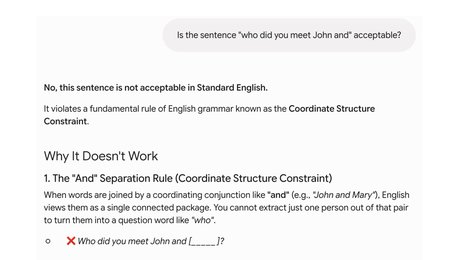
Does it produce human-like judgments & behavior? — plausible
ChatGPT
ChatGPT
Developmental adequacy
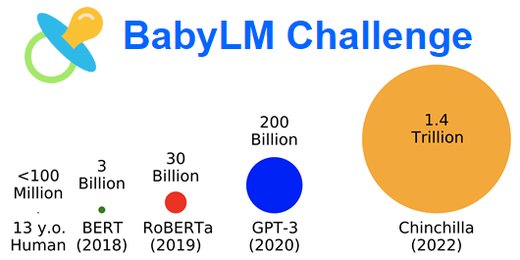
Can it learn from child-realistic data & experience? — open
BabyLM Challenge
BabyLM Challenge
Mechanistic adequacy
Does it use representations & computations like the human brain? — unknown

F. Pulvermüller
F. Pulvermüller
Current models train on far more text than children receive, from written corpora — not speech, interaction, perception, or social context. This limits, but does not erase, the proof-of-possibility result.
Piantadosi (2024); Warstadt & Bowman (2022)
8 · Debate map & handoff

The real debate: what must a theory explain?

Competence
Can the system capture grammatical generalizations?
Learning
Can it acquire them from realistic experience?
Explanation
Must the theory be interpretable, symbolic, neurally grounded?
LLMs should not end linguistic theory — they should force it to become more explicit, comparative, and empirically testable.
Not refutation by default — a serious challenge that shifts the burden of proof.
Piantadosi (2024)
1 / 8 · ← → / space to navigate